When it comes to illumination, most people think of a Flashlight as a simple tool for lighting up dark spaces. Yet there’s a whole category of flashlights designed not just to brighten your surroundings but to reveal the unseen. These are UV flashlights—also known as black lights—and they can expose details invisible to the human eye, from hidden stains and counterfeit bills to insect traces and security markings. At Helius, we’ve developed an advanced line of UV flashlights that serve professionals and industries worldwide, combining precision wavelength control and high-efficiency LEDs for maximum detection performance.
What is a UV flashlight and how does it work?
A UV flashlight works by emitting ultraviolet light, a form of electromagnetic radiation that sits just beyond the visible light spectrum. Human eyes cannot see UV rays directly, but when they hit certain substances, those substances fluoresce—meaning they absorb UV light and re-emit it as visible light. This reaction is what makes hidden stains, minerals, or security inks suddenly glow.
There are three general types of UV light: UV-A, UV-B, and UV-C. Most UV flashlights use UV-A light, which has wavelengths between 320–400 nanometers. This range is safe for consumer and professional use while still providing strong fluorescence effects. UV-C, on the other hand, is much shorter in wavelength and primarily used for disinfection purposes. The precision and stability of wavelength output determine how effective a flashlight is at revealing concealed materials—and that’s where high-quality LED design becomes critical.
Helius UV flashlights are engineered to maintain consistent UV-A emission, using carefully selected LEDs and integrated heat control to ensure performance stability even under continuous use.
Common and high-value uses of UV flashlights
The appeal of UV flashlights lies in their surprising range of applications. They are used not only by forensic professionals and security inspectors but also by everyday users in home, travel, and maintenance settings.
1. Forensics and crime scene analysis
Investigators rely on UV flashlights to locate evidence such as biological stains, fibers, or residues that are invisible under normal light. The precision of wavelength exposure helps detect even faint traces, contributing to accurate crime reconstruction and laboratory verification.
2. Cleaning and hygiene inspections
Hotels, hospitals, and cleaning companies use UV flashlights to verify cleanliness. Even after a surface appears spotless to the naked eye, UV illumination may reveal organic residues or unclean areas. This makes the UV flashlight a powerful inspection tool for ensuring high hygiene standards in hospitality and healthcare sectors.
3. Pest and scorpion detection
In regions where scorpions or bedbugs are a concern, UV black lights can help spot them instantly. Many pests fluoresce under UV light, allowing homeowners and pest control professionals to detect infestations early and take targeted action.
4. Document and currency verification
Government agencies and financial institutions use UV flashlights to authenticate ID cards, passports, and banknotes. Security inks embedded within these documents glow under UV light, providing instant verification against forgery or tampering.
5. Industrial and repair inspection
Mechanics and engineers use UV lights to detect leaks in refrigeration systems or fuel lines when combined with fluorescent dyes. It’s also used to inspect welds, adhesives, or coatings in quality control environments.
From professional forensics to simple hotel room checks, UV flashlights are bridging the gap between visible and invisible worlds, bringing hidden information to light in seconds.
Safety and legal considerations
While UV flashlights are safe when used properly, understanding basic precautions ensures responsible and effective use.
First, never shine UV light directly into eyes or on skin for extended periods. Though UV-A light is less harmful than UV-B or UV-C, prolonged exposure can still cause discomfort or eye strain. Wearing UV-protective glasses is recommended during professional inspection work.
Second, avoid using UV flashlights to scan individuals or animals unnecessarily, as some surfaces or organic materials may fluoresce unpredictably. Always follow product guidelines, especially for high-power UV flashlights with intense beam output.
Finally, in industrial or law enforcement applications, ensure compliance with local regulations regarding UV detection and document authentication tools. Responsible use maintains both operator safety and the integrity of inspection results.
Helius provides clear usage documentation and safety certifications with each product, ensuring our UV models meet international standards for professional and consumer use.
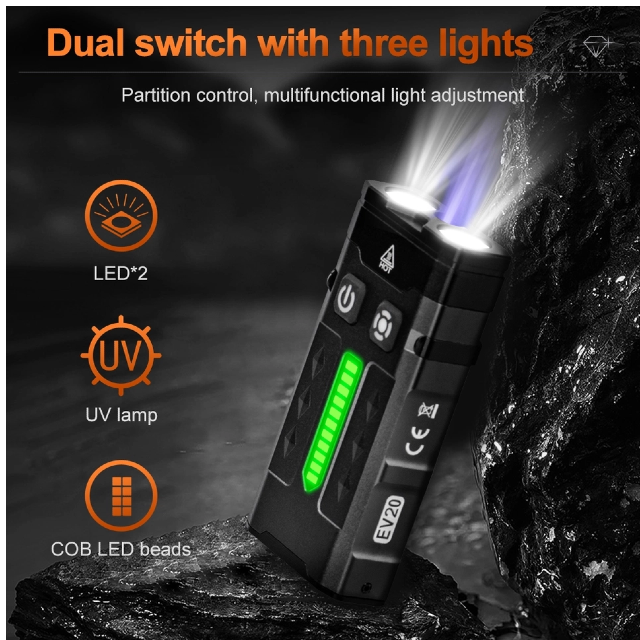
Technical specs that matter for UV flashlights
Not all UV flashlights are built equally. To achieve reliable fluorescence detection, several technical factors must align:
Wavelength precision: The effectiveness of a UV flashlight depends heavily on its wavelength range. The ideal range for most inspection and verification tasks is around 365–395 nm. Helius flashlights use precisely binned LEDs to maintain a consistent wavelength output, ensuring clear and repeatable results.
Output power (mW): Higher output intensity doesn’t always mean better detection. The beam must be balanced to avoid surface glare while still activating fluorescence. Helius engineers each model for optimal radiant intensity that maximizes contrast and detail visibility.
LED quality and lifespan: Cheap UV lights often degrade quickly, reducing their emission strength over time. Our LEDs are sourced from certified suppliers and tested under strict aging simulations to guarantee long service life.
Beam uniformity: Even light distribution matters when scanning surfaces or documents. Helius flashlights utilize optical-grade lenses to create an even, stable beam pattern that avoids hot spots or color distortion.
Construction and materials: From aerospace-grade aluminum housings to water-resistant seals, every detail ensures durability in demanding environments such as law enforcement or fieldwork.
These specifications together define the performance level of a professional UV flashlight—and they’re what set Helius models apart in the global UV Black Flashlight Wholesale market.
Industries driving wholesale demand for UV flashlights
The market for UV flashlights extends far beyond hobby use. Several industries have made them an indispensable part of daily operations:
1. Hospitality and cleaning services
Hotels and transport companies use UV flashlights to monitor cleanliness. From taxis to guest rooms, quick fluorescence checks verify sanitation before customer turnover.
2. Law enforcement and forensics
Police departments and crime labs require reliable UV flashlights for evidence detection, narcotic residue identification, and document verification. These organizations often purchase in bulk for field teams, driving consistent wholesale demand.
3. Industrial inspection services
UV flashlights are used in equipment maintenance, leak detection, and non-destructive testing. Bulk procurement ensures consistent performance across inspection units.
4. Veterinary and pest control sectors
From detecting animal urine in clinics to scorpion spotting in rural areas, these professionals rely on UV lighting daily, often ordering wholesale units for teams in multiple locations.
5. Educational and research institutions
Universities and labs utilize UV lights for experiments and demonstrations in chemistry and biology courses. Reliable suppliers like Helius provide consistent wavelength control necessary for accurate experimental results.
This widespread usage has made UV flashlights one of the most stable product lines in the lighting industry, with wholesale customers seeking reliability, certification, and consistency above all.
Why Helius UV models are a trusted supplier choice
Helius, a leading LED Flashlight Manufacturer, stands at the forefront of UV lighting innovation. With over a decade of manufacturing experience, we combine precision engineering and quality assurance at every step—from LED sourcing to CNC machining and final assembly. Each UV model undergoes wavelength verification, brightness calibration, and endurance testing to ensure consistent output and reliability.
Our factory integrates advanced optical design, durable housing materials, and efficient heat dissipation systems, all aimed at maximizing performance and product life. We hold multiple international certifications and maintain strict QC standards to guarantee each batch meets customer expectations.
Whether it’s for inspection teams, hospitality services, or forensic professionals, Helius offers a complete UV flashlight lineup designed for accuracy, safety, and industrial-grade endurance. Our goal is simple: to make invisible details visible with technology you can trust.
Conclusion
A Flashlight isn’t just about illumination—it’s about discovery. UV flashlights extend the boundaries of what light can reveal, uncovering stains, security marks, pests, and evidence that remain hidden to the naked eye. As one of China’s dedicated manufacturers, Shenzhen Tuliang Technology Co., Ltd. (Helius) continues to deliver professional-grade UV lighting solutions that empower industries to see beyond the visible spectrum. If you’re exploring advanced UV inspection tools or considering partnership for UV Black Flashlight Wholesale, contact us today to learn more or request a product sample.
FAQ
1. What is the ideal wavelength for UV flashlights?
The best wavelength range for most applications is between 365 nm and 395 nm, balancing safety with high fluorescence visibility.
2. Can UV flashlights damage eyes or skin?
Prolonged direct exposure should be avoided. Always wear UV-protective glasses during extended inspections.
3. Which industries use UV flashlights the most?
They’re widely used in law enforcement, hospitality, cleaning services, pest control, and industrial inspection fields.
4. Does Helius offer OEM or bulk customization?
Yes. As a professional manufacturer, Helius provides OEM, ODM, and UV flashlight wholesale options tailored to specific wavelength or design requirements.


