CE, RoHS, FCC & UKCA: Compliance Guide for Importers

You must meet CE, RoHS, FCC, and UKCA compliance requirements when importing products. These regulations protect markets and consumers. Failing to comply exposes you to legal penalties, market withdrawal, and costly recalls. See the risks below:
Risk Type | Description |
|---|---|
Legal Risk Mitigation | Non-compliance can lead to product seizures, fines, and legal action. |
Market Access | Products must meet regulatory standards to enter and remain in markets. |
Operational Continuity | Avoid delays, recalls, and costly redesigns by ensuring compliance early. |
You need to identify which regulations apply to your products. Take proactive steps and use tools like Helius to maintain compliance and access technical files.
Key Takeaways
Understanding CE, RoHS, FCC, and UKCA compliance is crucial for importers. These regulations protect consumers and ensure product safety in various markets.
Failing to comply with these regulations can lead to legal penalties, product recalls, and market access issues. Always verify compliance before importing products.
Use tools like Helius to manage compliance efficiently. This platform helps track regulations, maintain documentation, and reduce errors in the import process.
Compliance Marks Overview for Importers

What Is CE, UKCA, RoHS, and FCC?
You must understand the main compliance marks before importing products. Each mark shows that products meet specific regulations and certification standards. See the table below for official definitions and purposes:
Mark | Definition | Purpose |
|---|---|---|
CE | A mandatory conformity mark for products sold in the EEA, indicating compliance with EU standards on safety, health, and environmental protection. | To ensure product safety and compliance in the European market. |
UKCA | A mark for products sold in Great Britain, similar to CE, ensuring compliance with UK regulations. | To demonstrate compliance with UK product safety standards. |
FCC: This certification is mandatory in the United States for electronic devices that emit radio frequency energy. It ensures products do not cause harmful electromagnetic interference.
RoHS: RoHS compliance limits the use of hazardous substances in electronics. This regulation reflects a global focus on sustainability and safety.
You see these marks on electrical devices, machinery, medical devices, and telecom equipment. CE and UKCA marks cover a wide range of products. RoHS applies to household appliances, IT equipment, lighting, and other electronic products. FCC certification covers mobile phones, routers, switches, and wireless devices.
Why Importers Need Compliance
You must follow compliance requirements to avoid legal risks and protect your business. Regulations set strict standards for products entering the EU, UK, and US markets. As an importer, you need to check if your products require CE, UKCA, RoHS, or FCC certification. Meeting compliance requirements helps you access new markets and prevents costly recalls. You show buyers and authorities that your products meet safety and environmental standards. Regulations change often, so you must stay updated and keep your certification documents ready. Compliance protects your reputation and ensures your products remain on shelves.
Product Scope and Legal Duties
Which Products Need CE, UKCA, RoHS, or FCC?
You must know which products require certification before importing products into the EU, UK, or US. Each region enforces specific compliance requirements for different product categories. The table below shows common products and the marks they need:
Product Category | Compliance Mark(s) |
|---|---|
Toys | CE |
Electronics | CE, FCC |
Personal Protective Equipment (PPE) | CE |
Medical Devices | CE |
Machinery | CE |
Gas Appliances | CE |
Lifts | CE |
Energy-related Products | CE |
LED Lighting Products | CE |
Bicycles | CE |
Measuring Instruments | CE |
Eyewear | CE |
Wrist Watches | CE |
AC Adapters | CE |
Construction Materials | CE |
You see that most electronics, toys, and machinery need CE certification. If you import electronics into the US, you also need FCC certification. UKCA certification applies to products entering Great Britain. RoHS compliance is necessary for electronics and electrical equipment in both the EU and UK. You must check the regulations for each market before importing products. This step helps you avoid legal issues and ensures product compliance.
Tip: Always review the latest regulations for your target market. Rules can change, and new product categories may require certification.
Importer Legal Responsibilities
As an importer, you have legal duties that go beyond simply buying and selling products. You must meet compliance requirements for CE, UKCA, RoHS, and FCC marks. Authorities hold you responsible for ensuring that products meet all legal standards before they reach the market.
The table below outlines your main legal responsibilities:
Responsibility | Description |
|---|---|
Check Declaration of Conformity (DoC) | You must verify the DoC provided by the manufacturer. |
Verify CE marking | You need to ensure that the product is correctly CE marked. |
Ensure technical documentation | You must confirm that the manufacturer has the required technical documentation. |
Confirm conformity assessment | You should ensure that a conformity assessment procedure, such as lab testing, has been conducted. |
Provide user instructions | You must ensure that user instructions are available in the national language of the EU member state where the product will be sold. |
Indicate company name | You should indicate your company name on the product, packaging, and user instructions if possible. |
You must keep all compliance documents ready for inspection. Customs authorities may reject shipments if you do not provide the correct paperwork. If you fail to meet importer responsibilities, you risk legal penalties, including fines and product seizures. You may also face product recalls or sales bans if you cannot prove product compliance.
Importing products without the correct mark can lead to delays, fines, or seizures.
You are legally responsible for compliance, not just the manufacturer.
Customs authorities may reject shipments if mandatory documentation is missing, which can result in destruction of non-compliant products.
Failure to provide compliance documents can result in product recalls or sales bans.
You must treat importer obligations seriously. Meeting legal requirements protects your business and ensures that ce marked products remain available in your target markets. Always check certification and documentation before importing products. This approach helps you avoid legal trouble and supports ongoing compliance.
CE Marking for Importers
CE Requirements and Process
You must follow a clear ce marking process to ensure your products meet EU regulations. Start by identifying the applicable directives and harmonized standards for your products. Misidentifying directives can lead to costly mistakes. Next, perform a conformity assessment. This step may require lab testing, either in-house or through third-party evaluations. You need to compile and maintain technical documentation for each product. Draft and sign the declaration of conformity to confirm compliance. Finally, affix the ce marking to your products.
Here is a step-by-step guide for the ce marking process:
Identify applicable directives and harmonized standards.
Perform a conformity assessment, including lab testing.
Compile and maintain technical documentation.
Draft and sign the declaration of conformity.
Affix the ce marking.
Note: The ce marking is declarative. Without a rigorous compliance process, the logo alone does not guarantee certification.
Common challenges include sluggish Notified Bodies, limited knowledge resources, and document control best practices. The complexity of European regulations and evolving standards can lead to errors. Non-compliance may result in blocked shipments or product suspensions.
CE Documentation for Importers
You must keep documentation ready for customs checks and audits. Maintain the declaration of conformity for each product. Accredited lab testing reports confirm that your products meet required standards. Technical files should include product specifications, component lists, and conformity assessment records. For high-risk products, NB certification is necessary.
Description | |
|---|---|
Declaration of Conformity (DoC) | Signed document proving compliance. |
Accredited lab test reports | Confirm products meet required standards. |
Technical file | Contains specifications and conformity assessment records. |
NB certification | Needed for high-risk products under EU regulations. |
Keep product identification details, applicable standards, and lab testing information organized. You must maintain technical documentation for ten years and provide it upon request.
RoHS Compliance for Importers
RoHS Scope and Key Rules
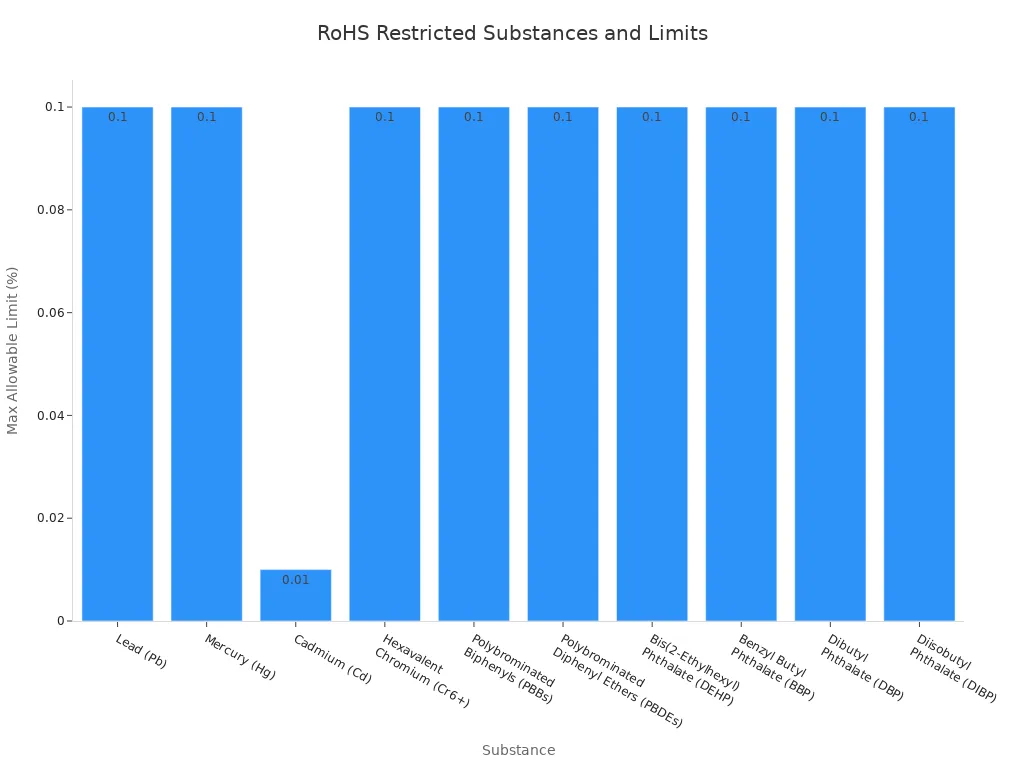
You must understand rohs compliance before importing electrical and electronic products. RoHS regulations restrict hazardous substances in these products to protect consumers and the environment. RoHS covers items like computers, phones, household appliances, and lighting. You need to check for restricted substances in every component. The table below shows the maximum allowable limits for each restricted substance:
Substance | Maximum Allowable Limit |
|---|---|
Lead (Pb) | 0.1% by weight in homogeneous materials |
Mercury (Hg) | 0.1% by weight in homogeneous materials |
Cadmium (Cd) | 0.01% by weight in homogeneous materials |
Hexavalent Chromium (Cr6+) | 0.1% by weight in homogeneous materials |
Polybrominated Biphenyls (PBBs) | 0.1% by weight in homogeneous materials |
Polybrominated Diphenyl Ethers (PBDEs) | 0.1% by weight in homogeneous materials |
Bis(2-Ethylhexyl) Phthalate (DEHP) | 0.1% by weight in homogeneous materials |
Benzyl Butyl Phthalate (BBP) | 0.1% by weight in homogeneous materials |
Dibutyl Phthalate (DBP) | 0.1% by weight in homogeneous materials |
Diisobutyl Phthalate (DIBP) | 0.1% by weight in homogeneous materials |
RoHS compliance helps you avoid hazardous substances and ensures your products meet safety standards.
RoHS Steps for Importers
You must follow clear steps to achieve rohs compliance. Start by determining if rohs applies to your products. Evaluate suppliers and components for restricted substances. Request certificates of conformity from suppliers. Integrate rohs standards into your manufacturing process. Schedule regular testing for hazardous substances and document results. Stay informed about rohs regulations by subscribing to industry updates.
Determine rohs applicability for your products.
Evaluate suppliers and components for restricted substances.
Implement rohs-compatible manufacturing processes.
Conduct rohs testing and certification.
Stay updated on rohs regulations.
Regular audits and supplier checks help you maintain rohs compliance and avoid penalties.
EU vs UK RoHS Differences
You must know the differences between EU and UK rohs regulations. The table below highlights key aspects:
Aspect | EU RoHS Regulations | UK RoHS Regulations |
|---|---|---|
Marking Requirements | CE marking can be used if technical exemptions match EU | UKCA marking required if exemptions differ from EU |
Declaration of Conformity | Must reference EU regulations | Must reference UK regulations |
Change Management | Updates by European Commission and Council | Divergence in technical exemptions may occur |
RoHS compliance in the UK requires UKCA marking and referencing UK regulations. You must monitor changes in technical exemptions. Non-compliance can lead to financial penalties, product recalls, and legal action. You protect your business by following rohs compliance rules for both the EU and UK.
FCC Rules for Importers
FCC Certification Basics
You must understand fcc certification before importing electronic products into the United States. The Federal Communications Commission sets strict regulations for devices that emit radio frequency energy. These rules help prevent interference with other electronic equipment and protect users. If you plan to sell, import, market, or distribute products in the U.S., you need to check if your devices require fcc certification. This applies to any product with a wireless transmitter or digital electronics, even if it is not wireless.
Common products that need fcc certification include:
Mobile phones
Wireless devices
Bluetooth gadgets
IT equipment
Power adapters
Radio and telecommunications terminal equipment
You must meet several requirements for fcc certification. The table below summarizes the basics:
Requirement Type | Description |
|---|---|
FCC Certification | Devices emitting RF energy must pass testing and receive a Grant of Equipment Authorization. |
Labeling | Products must display the FCC logo, FCC ID, and a compliance statement. |
Compliance Evidence | You must provide documentation, such as FCC IDs, to prove compliance. |
FCC Steps for Importers
You need to follow a clear process to achieve fcc certification for your products. Start by arranging compliance testing at an authorized lab. Next, obtain an FCC Registration Number and a Grantee Code. File your application with a Telecommunication Certification Body (TCB) and submit all required documents, including technical reports. After review, you will receive a grant of certification. Then, label your products and packaging with the correct FCC information. Keep all documentation organized for future reference.
Here are the main steps for fcc certification:
Arrange compliance testing at an authorized lab.
Obtain an FCC Registration Number.
Get a Grantee Code.
File an application with a TCB for certification.
Submit technical reports and documents.
Receive the grant of certification.
Label your products and packaging.
Maintain all compliance records.
Tip: Always check for updates to FCC regulations. Staying informed helps you avoid delays and ensures your products meet all compliance requirements.
UKCA Marking for Importers
UKCA Requirements and Process
You must follow a clear process to achieve ukca marking for your products. The ukca marking shows that your products meet UK safety and compliance standards. You start by identifying which UK regulations apply to your products. Next, you conduct a conformity assessment. Some products allow self-certification, while others require a third-party assessment by a UK-approved body. You create technical documentation that proves your products meet all relevant standards. You issue a Declaration of Conformity, stating your products comply with UK regulations. Finally, you affix the ukca marking to your products, packaging, or documents.
Here is the step-by-step process for ukca marking:
Identify applicable UK regulations for your products.
Conduct conformity assessment (self-certification or third-party).
Create technical documentation to show compliance.
Issue a Declaration of Conformity referencing UK regulations.
Affix the ukca marking to your products, packaging, or documentation.
Tip: Keep your technical documentation organized. You may need to show proof of compliance during inspections.
UKCA vs CE Differences
You need to understand the differences between ukca marking and CE marking. Both marks show compliance, but they follow different regulations and apply to different markets. The table below highlights the main differences:
Aspect | UKCA Marking | CE Marking |
|---|---|---|
Governing Regulations | Applicable UK regulations (e.g., Electrical Equipment (Safety) Regulations 2016) | EU directives and regulations (e.g., Low Voltage Directive) |
Mandatory Use | Required for certain products in the UK post-Brexit | Required for products in the EU market |
Deadline for Transition | Importers can use CE marking until 31 December 2024 | N/A |
Specific Product Differences | Mandatory for aerosol dispensers in the UK | Not required for aerosol dispensers in the EU |
You must use ukca marking for products sold in Great Britain. CE marking remains necessary for products entering the EU. Some products, like aerosol dispensers, require ukca marking in the UK but not CE marking in the EU. You need to check which mark applies to your products and follow the correct process for each market.
Ongoing Compliance Tips
Audits and Supplier Checks
You need to check your suppliers and audit your products regularly. Market surveillance authorities can seize non-compliant products at customs. You must understand the specific requirements for CE, RoHS, FCC, and UKCA regulations. Plan compliance early in product development. Work with experienced suppliers who know how to avoid hazardous materials. Keep accurate documentation for every product. If you miss a step, you risk delays or losing access to international markets.
Review supplier certifications for hazardous substances.
Schedule audits to verify compliance with regulations.
Maintain records for each product, including test results and certificates.
Choose suppliers with a strong track record in compliance.
Market surveillance authorities look for clear documentation and proper labeling. You protect your business when you check products before shipping. CE marking is mandatory for products sold in the European Economic Area. UKCA marking is required for products in Great Britain after Brexit. You must avoid hazardous materials to meet RoHS standards.
Staying Updated on Rules
You must stay informed about changes to regulations. Join industry associations or trade groups to receive alerts about new rules. Attend webinars and workshops to hear from experts and regulators. Set up a schedule to review compliance requirements for your products. Use professional compliance consultants for guidance and access to specialized resources.
Subscribe to newsletters from regulatory bodies.
Attend conferences to learn about updates to hazardous substance restrictions.
Review regulations for CE, RoHS, FCC, and UKCA regularly.
Monitor changes in market surveillance authorities’ enforcement.
Recent updates include stricter performance evaluation for CE marking, expanded scope for hazardous substances under EU RoHS, and new UKCA requirements after Brexit. You must keep your compliance process current to avoid penalties and protect your products.
Avoiding Common Pitfalls
Documentation Mistakes
You need to pay close attention to your paperwork when importing products. Many importers make mistakes that lead to delays or rejected shipments. Missing signatures or mandatory statements can cause authorities to flag your documents. Incorrect commodity codes on invoices or wrongly declared currency often result in confusion at customs. Vague product descriptions make it hard to identify hazardous materials. Incomplete consignee or shipper information can prevent products from entering the market. If you use the wrong HS code or customs valuation methodology, you risk fines. Missing or incomplete origin declarations also create problems. Misuse of incoterms leads to disputes about responsibility.
Missing signatures or mandatory statements
Incorrect commodity codes or HS codes
Vague or inaccurate product descriptions
Wrong customs valuation or currency
Incomplete consignee or shipper information
Missing or incomplete origin declarations
Misuse of incoterms
Keep your documentation clear and accurate. You protect your business from costly errors and ensure your products meet regulations.
Product Scope Errors
You must understand which regulations apply to your products. Many importers make mistakes when determining product scope for CE, RoHS, FCC, or UKCA compliance. If you use CE reports instead of UKCA evidence, you risk selling non-compliant products. Forgetting to appoint a UK Responsible Person leaves hazardous products without proper oversight. Incorrect UKCA label placement can lead to penalties. Fake or incomplete test reports fail to prove compliance.
Compliance Error | Description | How to Avoid |
|---|---|---|
Using CE Reports Instead of UKCA Evidence | CE reports reference EU law, but UKCA needs UK legislation. | Update test reports to reference UK regulations. |
Missing UK Responsible Person | Hazardous products need a UK-based representative. | Appoint a UK Responsible Person and document this. |
Incorrect UKCA Label Placement | Improper label size or location causes non-compliance. | Follow UKCA label rules: minimum 5mm height, visible, legible, indelible. |
Fake or Incomplete Test Reports | Generic reports do not protect against hazardous materials. | Verify reports with the issuing lab and ensure they match your products. |
Review your product scope and documentation regularly. You avoid penalties and keep hazardous products out of the market.
Helius Solutions for Importer Compliance
How Helius Supports CE, UKCA, and RoHS
You can use Helius to simplify compliance for your products. Helius helps importers manage CE, UKCA, and RoHS requirements with a user-friendly platform. You upload supplier data and technical files in one place. Helius checks your products against regulations and flags missing information. You track RoHS testing results and CE certificates easily. Helius guides you through UKCA marking steps and keeps your documents organized. You avoid confusion by following clear instructions for each regulation. Helius connects you with suppliers and helps you collect validated data. You reduce mistakes and save time when preparing products for market entry.
Helius gives you real-time alerts about changes in regulations. You stay ahead and keep your products compliant.
Benefits for Importers
Helius offers measurable benefits for importers who need to meet CE, UKCA, and RoHS standards. You gain access to high-quality supplier data and improve accuracy. You save time and money by consolidating information across departments. Helius reduces stress by making compliance management easier. You build trust with suppliers and improve risk assessment. The table below shows the impact for importers:
Benefit Description | Measurable Impact |
|---|---|
Simplified collection and management of supplier data | Saves time and money for over 100 global buying organizations |
Reduced overwhelm in managing supply chain compliance | Enhanced collaboration and community support |
Access to high-quality, validated primary data from suppliers | Improved data accuracy and reliability |
Increased efficiency for suppliers leading to enhanced trust | Positive impact on risk assessment |
Consolidated supplier data across departments | Time and cost savings across multiple departments |
You use Helius to keep your products compliant with CE, UKCA, and RoHS regulations. You avoid costly errors and improve your compliance process. Helius supports importers who want to protect their business and meet regulatory standards.
You achieve ce, RoHS, FCC, and UKCA compliance by following these steps:
Develop new product specifications for ce regulations.
Design products with ce and safety in mind.
Test and certify ce marks for all regulations.
Maintain ce documentation for ongoing compliance.
Key Factors to Consider | Description |
|---|---|
Jurisdiction expertise | Support for ce regulations in EU, UK, US |
Deliverables | SOPs, templates, ce training, audit support |
Experience | References with ce importers |
Training options | Live, recorded, ce-focused |
Ongoing support | Updates for ce regulations |
Pricing transparency | Clear ce fee breakdowns |
Industry fit | Experience with ce device types |
You review your ce compliance status and seek expert help for ce regulations. Helius supports ce compliance and keeps you updated on ce requirements.
FAQ
What happens if you import non-compliant products?
You risk fines, product seizures, and market bans. Authorities may also require you to recall or destroy non-compliant products.
Do you need to keep compliance documents after import?
Yes. You must keep all compliance documents for at least ten years. Authorities may request them at any time.
Can you use CE marking for products in the UK?
No. You must use the UKCA mark for products sold in Great Britain. CE marking applies only to the EU market.
See Also
Essential Insights Into Flashlight Production Processes In China
Key Quality Criteria For LED Flashlights From China Suppliers
Thorough Overview Of EDC Flashlights In Wholesale Industry
Evaluating Quality Standards For Headlamp Wholesale Suppliers