How Importers Can Match Lumen Output with Regional Market Preferences for Helius Flashlights


You can match lumen output with regional preferences by studying how people in each market use flashlights and what their visibility needs are. As a flashlight supplier, you must focus on quality and performance to satisfy both everyday and specialized users. When you offer a range of flashlights, including those with custom features, you gain a strong advantage. Meeting these needs helps you stand out and ensures your products deliver real value.
Key Takeaways
Understand regional flashlight needs by studying how different customers use them. Tailor your products to meet these specific preferences.
Focus on quality and performance. Offering a range of flashlights with customizable features helps you stand out in the market.
Stay updated on local regulations and standards. Compliance ensures your products meet safety requirements and gain market access.
Monitor customer feedback regularly. Use insights to improve your products and adapt to changing market trends.
Customize your flashlights for tactical and outdoor users. Features like durability, high lumen output, and adjustable brightness enhance user satisfaction.
Identifying Regional Preferences

Market Segments and Use Cases
You need to understand how different customers use flashlights in each region. Outdoor enthusiasts, emergency responders, and everyday users all have unique needs. In North America, many people use flashlights for camping, hiking, and emergency preparedness. This trend drives market growth as more consumers seek reliable lighting for outdoor activities and safety. In Europe, you will notice a similar pattern, but with a stronger focus on sustainable products. The Asia-Pacific region shows increased demand due to urbanization and higher disposable incomes, which leads to more interest in outdoor adventures. In the Middle East and Africa, infrastructure development and a focus on safety shape the market. As a flashlight supplier, you must identify these segments to match your products with local preferences.
Tip: Create a simple table to track the main use cases in each region. This helps you align your product features with customer needs.
Region | Main Use Cases | Key Needs |
|---|---|---|
North America | Outdoor, Emergency | High visibility |
Europe | Outdoor, Sustainable Living | Eco-friendly, visibility |
Asia-Pacific | Urban, Outdoor | Versatility, visibility |
Middle East/Africa | Safety, Infrastructure | Durability, visibility |
Visibility Needs by Region
Visibility in low-light conditions remains a top priority for most users. You should pay attention to how much brightness customers expect in different markets. Some regions require high-output flashlights for outdoor use, while others prefer moderate brightness for daily tasks. Visibility in low-light conditions also depends on local weather and environment. For example, areas with frequent fog or rain may need flashlights with specific beam patterns. By understanding these preferences, you can offer products that meet the exact needs of your customers. Matching lumen output to regional expectations ensures your flashlights deliver the right level of performance.
Analyzing Local Factors for Flashlight Supplier Success
Regulations and Standards
You must navigate a range of local regulations when importing flashlights. Each market sets its own requirements for documentation and product standards. For example, you need to prepare a commercial invoice, certificate of origin, and certificate of conformity to verify product details and compliance. The table below shows the essential documents for major markets:
Required Document | Description |
|---|---|
Commercial Invoice | Detailed record of the transaction, including product description, quantity, and value. |
Certificate of Origin | Verifies the country of manufacture and determines eligibility for preferential tariffs. |
Certificate of Conformity (CoC) | Confirms that flashlights meet local safety and quality standards. |
In Qatar, you must comply with the Qatar General Organization for Standards and Metrology, which requires a certificate of conformity. Bahrain enforces strict labeling and documentation rules through its Standards and Metrology Directorate. Kuwait mandates a technical inspection report for imports. As a flashlight supplier, you should stay updated on these regulations to maintain product quality and market access.
Climate and Environment
Local weather conditions influence the features your flashlights need. Clear nights allow maximum beam distance, while fog and rain reduce visibility and require specialized beam patterns. Snow creates glare, so warmer color temperatures work better. High humidity and dust can scatter light, making adjustable beams and waterproof designs essential. The table below highlights how climate affects flashlight performance:
Weather Condition | Impact on Beam Distance | Visibility Effect | Best Flashlight Type |
|---|---|---|---|
Clear Night | Maximum rated distance | Sharp, focused beam | High-lumen throw flashlight |
Fog | Reduced range | “Light wall” effect | Low-intensity, wide flood beam |
Rain | Shorter range | Usable with reflection | Waterproof flashlight with medium throw |
Snow | Heavy glare | Loss of contrast | Warmer color temperature flashlight |
High Humidity | Slight scattering | Haze effect | Neutral-white LED beam |
Dust/Smoke | Diffused beam | Hazy visibility | Strong, focused beam with adjustable zoom |
You should select models that match local climate challenges to ensure reliable performance.
Cultural and Color Preferences
Cultural backgrounds shape preferences for flashlight color and design. In Scandinavia, people accept colored lights in public spaces due to their long blue hour. Southern Europe reserves colored lights for festivals. Nordic countries prefer cozy, warm lighting during winter and value layered light for comfort. Custom lens designs and color options help you appeal to these preferences. Unique lenses enhance product aesthetics and visibility in retail. You can engrave logos for branding and use high-definition printing to create realistic colored lenses. These features boost customer experience and set your products apart.
Tip: Custom lenses and color options allow you to tailor flashlights for each market, improving both appeal and performance.
Benchmarking Most Luminous Flashlights and Competitors
Reviewing High-Output Models
You need to compare the most luminous flashlights on the market to ensure your product line meets customer expectations. Many users look for models that deliver both high performance and reliability. The ThruNite Archer 2A C stands out for its wide range of brightness settings and a user-friendly two-button interface. This model gives you flexibility because it works with two AA batteries or a rechargeable battery. The Acebeam K1 EDC Flashlight also ranks among the most luminous flashlights. It offers a maximum output of 1000 lumens and a beam distance of 223 meters. You can see the key features in the table below:
Feature | Detail |
|---|---|
Model | Acebeam K1 EDC Flashlight |
Maximum Output | 1000 lumens |
Beam Distance | 223 meters |
Battery Modes | Low (9 lumens, 60 hrs), Medium (200 lumens, 2 hrs 40 min), High (1000 -> 650 -> 110 lumens, 1 min -> 30 min -> 30 min) |
Ingress Protection | IP68 (dustproof and waterproof up to 2 meters for 30 minutes) |
You will also find that many high-output models feature multi-function versatility, anodized aluminum alloy housing, and quality O-rings for water and dust protection. These features help you address the needs of customers who demand durability and strong visibility.
Customer Feedback and Trends
You should always monitor customer feedback to stay ahead of trends in the flashlight market. Many users of tactical flashlights express a preference for higher lumen levels because they want better visibility. Camping flashlight users often mention dissatisfaction with brightness and battery life. Mini flashlight users also want improved brightness and longer battery life. The table below summarizes these trends:
Trend Type | Customer Feedback Summary |
|---|---|
Tactical Flashlights | Preference for higher lumen levels due to brightness concerns. |
Camping Flashlights | Dissatisfaction with current brightness and battery life. |
Mini Flashlights | Need for improved brightness and battery life. |
You can respond to these needs by highlighting rechargeable and tactical features in your marketing campaigns. Educate your customers about the benefits of a high lumen led flashlight. By tracking trends and adjusting your product offerings, you position yourself as a leading flashlight supplier who understands the needs of every market segment.
Customizing Tactical and High Lumens Camping Flashlights
Tactical Flashlight Features
You need to focus on the specific requirements of tactical users when selecting a tactical flashlight for your product line. Law enforcement and military buyers demand rugged construction, multiple lighting modes, and compatibility with firearms. These features ensure that your flashlights perform reliably in critical situations where visibility can mean the difference between success and failure. You should prioritize advanced functionalities such as strobe modes and long battery life. These attributes support operations that require both discretion and powerful illumination.
A robust design is essential for tactical users. Choose materials like anodized aluminum or reinforced plastic to maximize durability. Shockproof construction helps your tactical flashlight withstand accidental drops and rough handling. You also need to consider waterproof ratings. Tactical users often operate in harsh environments, so a high waterproof rating ensures consistent performance. The table below outlines common waterproof ratings and their benefits:
Rating | Description |
|---|---|
IPX4 | Splash resistant from any direction. Great for light rain or brief water exposure. |
IPX7 | Submersible up to 1 meter for 30 minutes. Ideal for activities near water. |
IPX8 | Submersible beyond 1 meter. Perfect for extended water exposure or diving. |
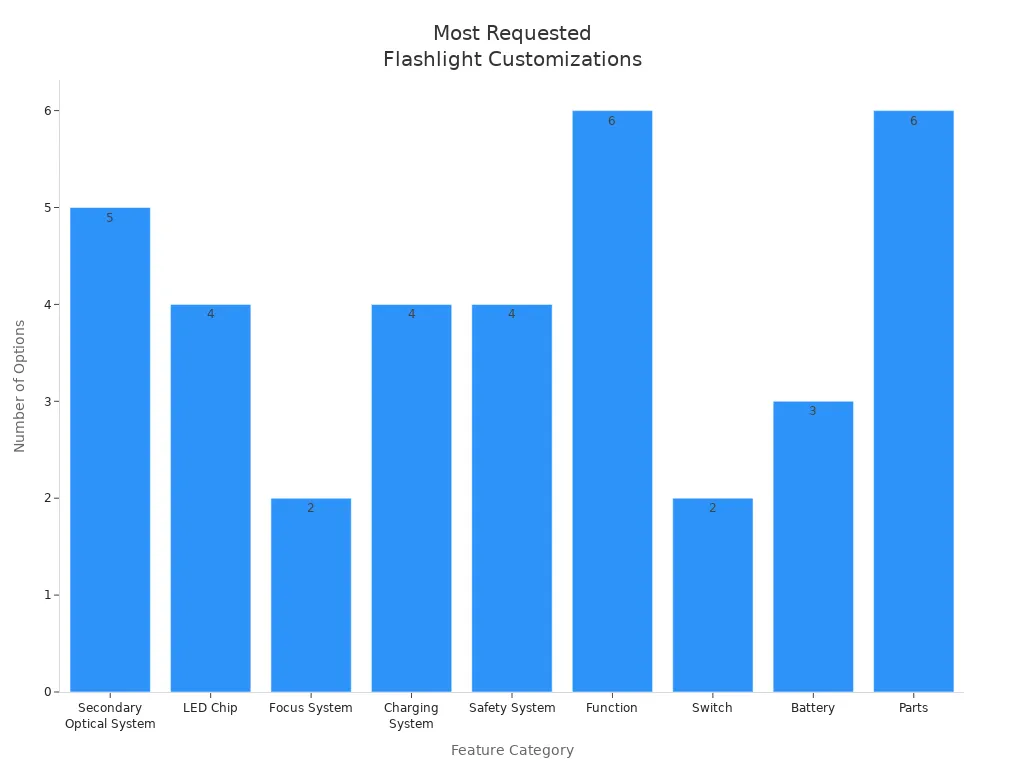
You should offer a range of customization options to meet the needs of the tactical segment. Many tactical users request features such as focusable lenses, advanced LED chips, and multiple charging systems. Rechargeable flashlights with overcharge and over-discharge protection provide added safety and convenience. The chart below shows the most requested customization options by feature category:
Tip: Customizing product features like switch type, battery options, and mounting accessories can help you stand out as a flashlight supplier in the tactical market.
You should also consider offering a wide range of lumen outputs, from 1000 to 80,000 lumens. This approach allows you to address the unique needs of tactical users, outdoor enthusiasts, and everyday consumers. Customizing your product line in this way increases customer satisfaction and loyalty, which can boost your sales and strengthen your reputation.
High Lumens Camping Flashlights for Outdoor Markets
Outdoor enthusiasts expect high lumens camping flashlights to deliver reliable performance in a variety of conditions. The preferred lumen output for camping flashlights ranges from 300 to 980 lumens. This range provides enough brightness for navigating dark environments and handling camping tasks like nightly walks or setting up tents. You should also offer models with adjustable brightness to give users control over visibility and battery life.
Durability remains a top priority for outdoor enthusiasts. Select flashlights made from impact-resistant materials and ensure they have shockproof designs. These features protect your products during backpacking, hiking, or accidental drops. Waterproof ratings matter as well. Choose models with at least an IPX4 rating for light rain, or go higher for activities near water or in wet climates.
Rechargeable flashlights have become a trend among outdoor enthusiasts. Models with rechargeable batteries reduce waste and offer convenience. You should highlight features like USB charging, magnetic charging, and overcharge protection. These product features appeal to users who value sustainability and ease of use.
You can further enhance your product recommendations by offering customization options. Many outdoor enthusiasts look for adjustable brightness, focus systems, and accessories like clips, pouches, or lanyards. The table below summarizes popular customization options for both tactical and outdoor flashlights:
Feature Category | Customization Options |
|---|---|
Secondary Optical System | Focusable lens, Convex lens, Plano-convex lens, Fresnel lens, Parabolic reflector |
LED Chip | Cree, Osram, Luminus, Nichia |
Focus System | Sliding focus, Twist focus |
Charging System | DC charging, AC charging, Magnetic charging, USB Charging |
Safety System | Overcharge protection, Over-discharge protection, High-temperature protection, Low-temperature protection |
Function | Anti-impact, Tactical, Magnetic hanging, Glow in the dark, Proximity sensors, Waterproof and dustproof |
Switch | Front switch button, Tail switch button |
Battery | Rechargeable Li-ion, Rechargeable Li-polymer, Alkaline |
Parts | Mount, Clip, Pouch, Lanyard, Charger, Cable, Packaging |
Note: Offering adjustable brightness and rechargeable batteries in your high lumens camping flashlights will help you meet the evolving needs of outdoor enthusiasts and keep up with trends in the market.
By focusing on durability, high lumen output, and customizable product features, you can deliver flashlights that exceed the expectations of both tactical users and outdoor enthusiasts. This approach positions you as a leader in performance and innovation, ensuring your products remain relevant as trends shift and customer needs evolve.
Validating Product-Market Fit and Visibility
Pilot Launches and Testing
You can validate your product-market fit by running pilot launches in selected regions. Pilot testing acts as a bridge between your development process and a full-scale market rollout. This step helps you reduce risk and ensures your tactical and outdoor flashlights meet real-world needs. You gather actionable feedback and prepare your team for a broader launch. Pilot launches allow you to test performance, usability, and visibility in actual conditions. You can identify issues early and make adjustments before committing to a larger investment.
The table below outlines how pilot launches contribute to successful market entry:
Evidence | Explanation |
|---|---|
Pilot testing serves as a vital bridge between controlled development environments and full-scale deployment. | Pilot testing helps transition from development to market, ensuring readiness for launch. |
It mitigates risks, gathers actionable feedback, and ensures both systems and operational teams are ready for broader rollout. | Pilot testing reduces potential issues and prepares teams for successful implementation. |
Pilot testing reduces risk in new product launches by validating performance, usability, and market fit with a small audience before a full rollout. | Validating key product aspects ensures market success. |
You should track key metrics during pilot launches to measure success and spot trends. These include sales volume, customer satisfaction, engagement, and market penetration. Monitoring these metrics helps you understand if your tactical products and other models meet customer needs and visibility expectations.
Feedback Loops for Continuous Improvement
You need to establish strong feedback loops to keep improving your products. Customer feedback reveals how users interact with your flashlights and highlights usability issues. Regular feedback collection helps you refine designs and address changing needs. When you act on user suggestions, you build trust and loyalty. This process encourages customers to advocate for your brand.
Best practices for collecting and analyzing feedback include:
Proactively seeking opinions through surveys, social media, and feedback forms.
Training staff to handle and respond to feedback professionally.
Using technology like CRM software to analyze feedback efficiently.
Reviewing feedback data regularly and using it to guide decisions.
A continuous feedback loop ensures your products stay relevant and competitive. You can quickly adapt to new trends and deliver tactical solutions that match evolving market needs and visibility requirements.
You can match lumen output with regional needs by following a clear process:
Centralize all feedback channels.
Categorize customer reviews by product and sentiment.
Analyze feedback frequency and severity.
Cross-reference reviews with sales and engagement data.
Develop action plans from insights.
Communicate changes to your customers.
Ongoing research and product customization help you stay competitive.
Partner with reliable suppliers for quality and cost efficiency.
Customize features to fit your market.
Review Frequency | Approach |
|---|---|
Continuous | Monitor trends and integrate new data |
Stay alert to seasonal shifts, sustainability concerns, and style trends to keep your product line relevant.
FAQ
What lumen range should you offer for different markets?
You should offer a broad range, from 300 lumens for daily use to 80,000 lumens for tactical or outdoor needs. This approach helps you meet the diverse requirements of each regional market.
How do you determine the right flashlight features for your region?
You can analyze local climate, regulations, and customer feedback. This research helps you select features like waterproofing, beam type, and color temperature that match your market’s needs.
Why do some regions prefer warmer color temperatures?
Regions with snow or heavy fog often prefer warmer color temperatures. Warmer light reduces glare and improves visibility in these conditions. You can use this insight to select the best LED options.
How can you collect effective customer feedback?
You can use surveys, social media, and direct outreach. Regularly review this feedback to identify trends and improve your product line.
Tip: Centralize all feedback channels for easier analysis. 📊
See Also
Finding Premium Flashlights for Your Import Business at Wholesale
Brighten Your Journeys with Helius Lights Flashlight Wholesale
Boosting Profits by Sourcing Flashlights from Wholesalers
Selecting the Best Wholesale Supplier for LED Flashlights
Expert Tips for Negotiating Home Flashlight Wholesale Prices