Rechargeable vs. Battery-Powered Diving Flashlights: Which Is Best for Your Accessories Bag?

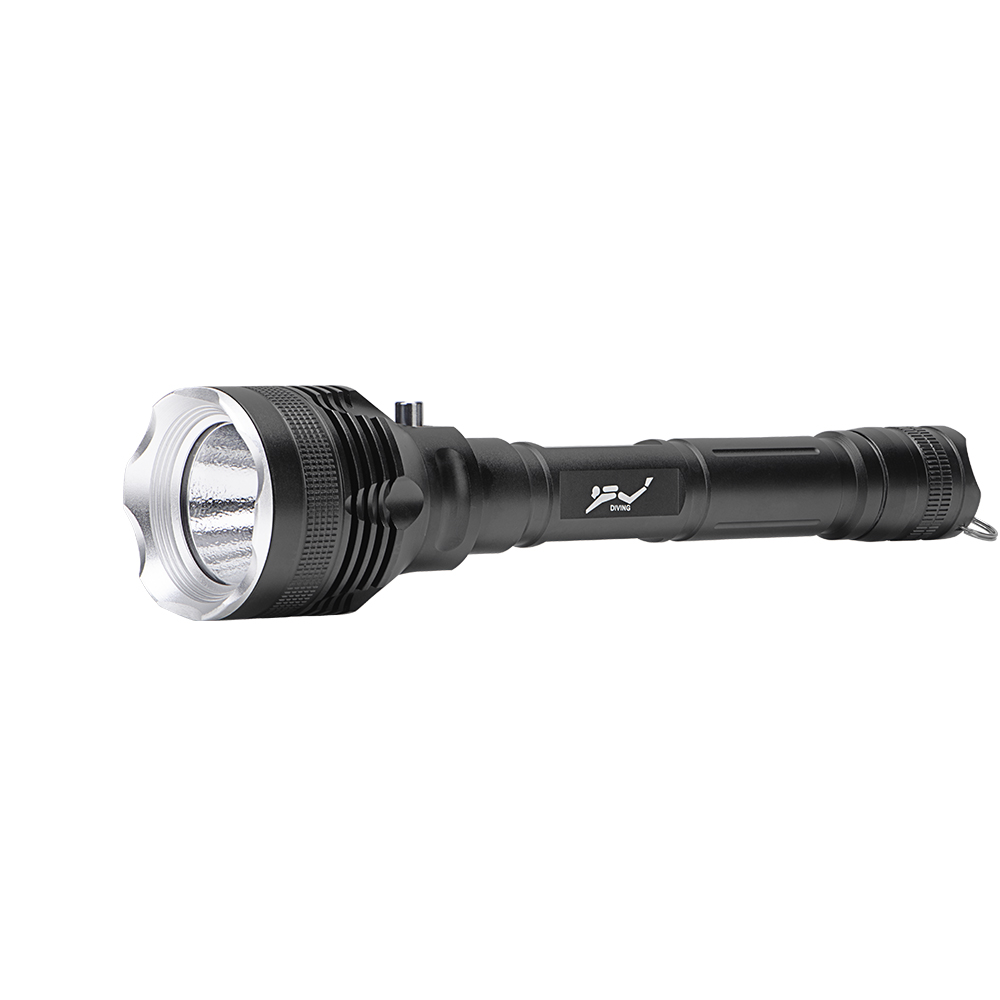
For many divers, a rechargeable scuba diving flashlight is a good choice for your accessories bag. It works well, is easy to recharge, and saves money over time. You can count on it for night dives or deep wrecks. When picking a flashlight, think about how reliable it is, how easy it is to use, how much it costs, how well it works, and how you like to dive. What you pick helps you feel safe and sure when you dive.
Key Takeaways
Rechargeable diving flashlights help you save money over time. You do not need to buy new batteries often. This makes them a good choice for people who dive a lot.
Pick flashlights that have more than one light mode. More modes let you change how bright the light is. This helps you see better and can make the battery last longer.
Always look at the battery level before you dive. A flashlight with a battery indicator shows if it is fully charged. This helps you start your dive with enough power.
Think about where you will be diving. Rechargeable flashlights work well in places with electricity. Battery-powered flashlights are better for places far from power.
Safety is very important. Test your flashlight before every dive. Keep a backup light in your bag. This makes sure you have light if your main flashlight stops working.
Quick Comparison
Key Differences
When picking a scuba diving flashlight, you want to know what makes rechargeable and battery-powered models different. Here is a simple chart showing some of the most popular models in each group:
Model | Price | Lumens | Waterproof Rating | Features |
|---|---|---|---|---|
Willcrew DX150 | $129.99 | 15000 | IPX-8 | 4 light modes, rechargeable, 320m underwater distance |
Underwater Kinetics C8 eLED | $190.00 | 900 | N/A | Rechargeable, switch between battery types |
ORCATORCH D710 | $159.95 | 3000 | IP68 | 4 brightness levels, user-friendly battery indicator |
Many top flashlights have more than one light mode. These modes let you change how bright your light is. You can pick a strong light or a softer one. This helps you save battery and see better in different places.
Tip: Always look at how many light modes a flashlight has. More light modes help you see better in different water conditions.
Rechargeable flashlights often have more light modes. You can charge them after each dive. This means you do not need to carry extra batteries. Battery-powered flashlights may have fewer light modes. But you can put in new batteries fast if you run out of power.
Warranty and support are important too. Some brands, like Acebeam, give you a 10-year warranty on their dive lights. Others, like PFSN Professioner, give you good support if you need help.
Acebeam: 10-year warranty on D30 Diving Flashlight
PFSN Professioner: Good warranty and support
When you look at these features, you see that rechargeable flashlights usually have more light modes and are a better deal over time. Battery-powered flashlights let you change batteries fast but may not have as many features.
Reliability
Underwater Dependability
You need a flashlight that works every time you dive. It is very important for your safety underwater. Both rechargeable and battery-powered flashlights can have problems. You should know what might go wrong before you buy one.
Both types can have electronic problems.
Sometimes, the power button gets stuck or stops working. This can leave you without light.
Even expensive flashlights can flood if the seals break.
Cheaper flashlights might not last as long. But some divers still like using budget models.
Pick a scuba diving flashlight that can handle water and pressure. Always check the seals and test your flashlight before each dive. If you see any problems with the button or electronics, fix or replace the flashlight right away. A good flashlight helps you stay safe and see well underwater.
Tip: Always keep a backup light in your bag. If your main flashlight stops working, you will still have light.
Safety Factors
Safety is very important when you choose a diving flashlight. Rechargeable flashlights use lithium-ion batteries. These batteries need careful charging. If you do not watch the charging, the battery can stop working. Sometimes, lithium-ion batteries make hydrogen gas when charging. If too much gas builds up, it can cause pressure and even break the flashlight.
Here is a table with some safety concerns:
Safety Concern | Description |
|---|---|
Battery Charging Risks | Charging can stress the battery and cause problems if not watched. |
Integrated Design | Good charging control makes the flashlight safer. |
Safety Record | Some brands have had no big problems with lithium-ion batteries since 2009. |
You should know about rare accidents. In December 1992, a flashlight exploded during firefighter training. Another explosion happened in 1995, but no one got hurt. These stories show why you must follow safety rules and use trusted brands.
Note: Always use the charger that comes with your flashlight. Do not charge near things that can catch fire.
Convenience
Charging vs. Replacement
When you pick a scuba diving flashlight, you want it to be easy to use. A rechargeable battery lets you plug in your light after diving. Many flashlights now use usb-rechargeable batteries. You can charge them with a simple cable. This is helpful if you have power nearby.
Some divers like to change batteries instead of waiting for charging. If your flashlight has a dual battery system, you can use both rechargeable and disposable batteries. This is useful on long trips or when you cannot charge.
Most rechargeable batteries last for one or two dives before charging.
Some flashlights need you to take out the battery to charge it. This is not as easy as plugging in the cable.
If your flashlight has a visual battery indicator, you can check the power before diving. This helps you avoid running out of light.
Tip: Always look at your battery level before diving. Checking the visual battery indicator can help you have a safe dive.
Real-World Use
On real dive trips, you may face problems. Sometimes, you cannot charge your flashlight in remote places. Bringing extra batteries is important if you want to dive many times in one day.
Good power management helps your rechargeable battery last longer.
Extra batteries make sure you always have light.
Charging can be hard on remote boats or off-grid places.
Battery canisters can last more than ten years. They keep about ninety percent of their burn time. If you dive a lot, your batteries may last five to seven years. Demo lights used every day may last just over two years. Charging your flashlight after every dive can wear out the battery faster. Plan your charging routine so your battery lasts longer.
Note: On days with many dives, bring extra batteries or a backup light. This keeps you safe and ready for every dive.
Cost & Value
Upfront vs. Ongoing Costs
When you shop for a scuba diving flashlight, you notice the price tag first. Rechargeable dive lights usually cost more at the start. Battery-powered models often look cheaper. You might think you save money by picking the lower price. Over time, the real cost shows up. You need to buy new batteries for battery-powered lights. These costs add up after many dives.
Here is a simple table to help you compare:
Feature | Rechargeable Flashlights | Battery-Powered Models |
|---|---|---|
Initial Cost | Higher | Lower |
Long-term Cost | Lower | Higher (due to battery replacements) |
Environmental Impact | Better (less waste) | Worse (more waste) |
You see that a rechargeable dive light costs more at first. You save money in the long run because you do not buy batteries again and again. You also help the environment by making less waste.
Rechargeable Dive Light Savings
A rechargeable dive light gives you real savings over time. You charge your light after each dive. You do not need to buy new batteries for every trip. This makes your gear bag lighter and your wallet happier. Many divers notice that the savings grow with each season.
You also get more value from a rechargeable dive light. Most models last for years with good care. You avoid the hassle of finding batteries in remote places. You also avoid the risk of running out of power during a dive. You can trust your rechargeable dive light to work when you need it most.
Tip: If you dive often, a rechargeable dive light pays for itself in less than a year. You spend less, carry less, and dive with more confidence.
Performance

Brightness & Output
When picking a scuba diving flashlight, brightness is important. You need a strong light to see well underwater. Most rechargeable models use high intensity led technology. This makes the beam powerful and helps you see details in dark water.
Here is a table that shows how bright some popular models are:
Flashlight Model | Brightness (Lumens) | Battery Type |
|---|---|---|
BESTSUN dive flashlight | 10,000 | 2 x 18650 lithium rechargeable |
Phantom Aquatics Impulse dive light | 90-700 | Rechargeable lithium-ion |
Princeton Tec 5 | 500 | Not specified |
Rechargeable flashlights usually have higher brightness. They use lithium-ion batteries that give strong power. This keeps the light bright for longer. Battery-powered flashlights with alkaline batteries are not as bright. They can make it hard to see in deep or wide areas.
You want your light to stay bright during your dive. Rechargeable lithium-ion batteries help keep the light steady. The light does not get dim fast. Battery-powered flashlights may start bright but get weaker as the battery runs out. This can leave you with a weak light before your dive is over.
Rechargeable lithium-ion batteries last longer.
They keep the light bright the whole dive.
Battery-powered flashlights may get dim as batteries run down.
If you want to see best, pick a flashlight with a strong led and good battery. This helps you stay safe and enjoy your dive.
Burn Time
Burn time means how long your flashlight stays on at full power. You want a light that lasts for your whole dive. Rechargeable models usually last longer because of their battery type.
Here is a table that compares burn times for different models:
Model | Burn Time at Full Power |
|---|---|
Dash 2.0 | 90 minutes |
R15 | 2 hours |
ST1000 | 1 hour |
Nova 850R | 2 hours |
SeaLife Sea Dragon Mini 1300S | 1.5 hours |
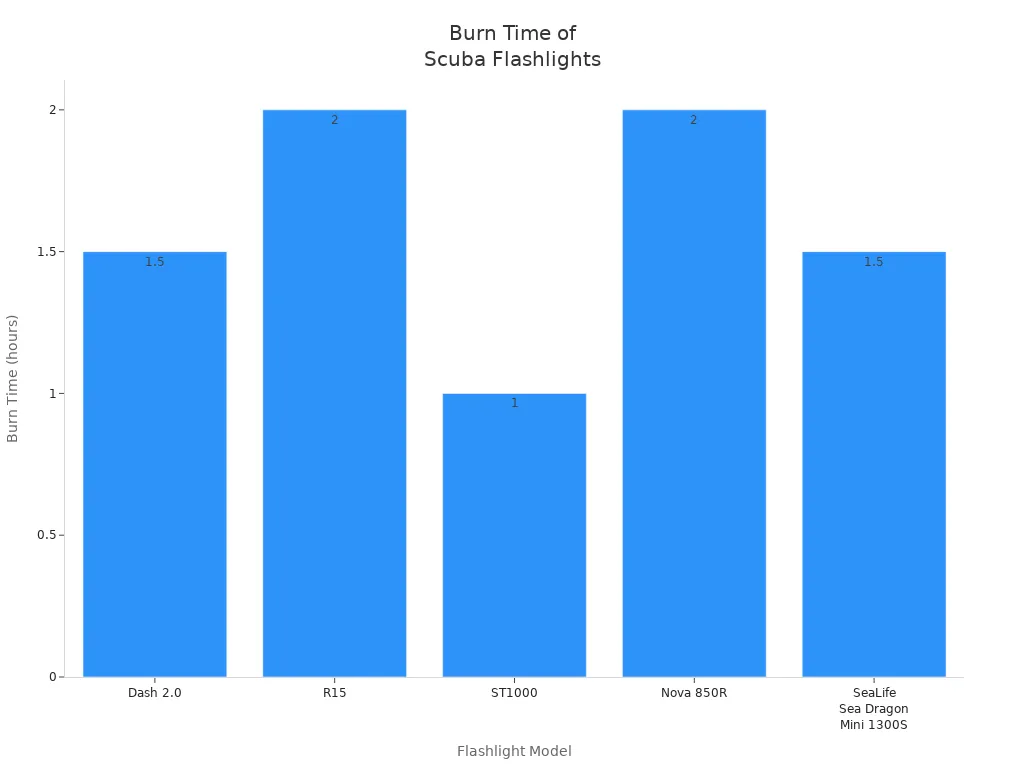
Lithium-ion batteries last longer than alkaline batteries. They work better when you need lots of power. Alkaline batteries lose energy faster and do not work well with high power. This means battery-powered flashlights do not last as long.
Feature | Lithium-Ion | Alkaline |
|---|---|---|
Internal Resistance | Lower | Higher |
Run Time | Longer | Shorter |
Performance Under Load | Better for high current | Poorer for high current |
Energy Loss | Less energy wasted | More energy wasted |
You should also think about how long it takes to charge. Most rechargeable flashlights need a few hours to charge all the way. If you want to dive many times in one day, bring a backup or extra battery. This helps you be ready for every dive.
Tip: Always check your battery before each dive. A fully charged flashlight gives you steady light and helps you feel safe.
Suitability
Recreational Diving
You need a flashlight that is simple and works well. Most instructors say to pick one that is strong but easy to use. The light should fit in your hand and help you see all around. A small dive torch is good for most fun dives. It helps you spot fish, look at reefs, and check your gear.
Here is a table with top picks for recreational divers:
Model | Features | Recommended For |
|---|---|---|
OrcaTorch D530 | Small, bright, 1300 lumens, narrow 8-degree beam | Recreational divers |
OrcaTorch D550 | 1000 lumens, simple and strong, wrist strap | Casual and technical dives |
These flashlights are bright and have a focused beam. You can put them in your accessories bag easily. Rechargeable scuba diving lights work well and let you see battery levels before you dive. You do not have to worry about losing power while underwater.
Tip: Pick a flashlight with a battery level indicator. You will know when to recharge and avoid problems underwater.
Technical & Cave
Technical and cave diving need flashlights that do more. You go deeper and stay underwater longer. You need a light that works in hard places and helps you see in the dark. Many technical divers pick rechargeable models because they are bright and last long. You get steady light for caves or wrecks.
Look for these things:
High lumens for bright light
Long burn time for long dives
Strong seals to stop water leaks
Easy battery checks
Technical divers often bring two or more lights. You need a backup if your main light stops working. Rechargeable flashlights with battery indicators help you plan your dives. You can recharge between dives and keep your gear ready.
Note: Always test your flashlight before you go into a cave or wreck. Bring a backup light to stay safe.
Travel & Backup
When you travel, you want gear that is light and easy to pack. A small dive torch fits in your bag and does not take up much space. Rechargeable models are good for travelers because you can charge them anywhere with a USB cable. You do not need extra batteries or have to find new ones far away.
Experienced divers suggest these backup tips:
Pick rechargeable lights for easy charging and small size
Find models with battery indicators
Pack an extra flashlight for emergencies
Rechargeable scuba diving lights make less waste and are easier to use. You can check the charge before each dive and recharge when you need to. You are ready for night dives or surprises.
Tip: Put a small backup light in your travel kit. You will have extra light if your main flashlight stops working.
Pros & Cons
Rechargeable Dive Light
Rechargeable dive lights have many good points for divers. You save money because you do not buy new batteries each trip. Most have strong aluminum alloy cases that last longer than plastic ones. If a part breaks, you can change just that part. This keeps repair costs low.
Advantage | Benefit Description |
|---|---|
You save 60-70% on operating costs compared to buying new batteries. | |
Durability | Aluminum alloy cases last three times longer than ABS plastic. |
Performance | Modular designs let you replace parts instead of the whole flashlight. |
Tip: Rechargeable models help you make less trash and keep your bag lighter.
But you need to plan for charging your light. Rechargeable batteries need time to charge between dives. You must have a place to plug in your charger. If you do not use the battery for a long time, it loses power. Some divers say the buttons are hard to press with gloves. Sometimes, the switches can get stuck. You may need extra charged batteries for long days.
Disadvantage | Description |
|---|---|
Charging Time | You must wait for the battery to recharge between dives. |
Power Source Needed | You need access to electricity to recharge. |
Charge Retention | Batteries lose charge if left unused for weeks. |
Usability | Some buttons or switches are hard to use with gloves. |
Burn Time | You may need more than one battery for long dive sessions. |
Battery-Powered
Battery-powered dive lights let you change batteries fast. You can get back in the water quickly. Many have tough, waterproof cases and switches that work with thick gloves. You can use wrist lanyards or clips to carry them. Some let you pick between rechargeable or disposable batteries, so you have more choices.
Tough, pressure-proof case keeps your light safe.
Switches are easy to use with gloves.
Waterproof seals protect the battery and bulb.
Wrist lanyards or clips help you carry the light.
Some have different power modes for longer battery life.
There are some problems too. Some divers say three lights broke in five years, and one broke during the warranty. If you do not close the case right, water can get in. Some people worry about lithium-ion battery fires, like the m/v Conception fire. These lights often lose power even when not used, so you must check and recharge them often. Flying with batteries can be hard because of travel rules.
Some lights break after a few years.
Water can get in if you do not seal the case right.
Lithium-ion battery fires can be a safety problem.
High self-discharge means you must check and recharge batteries often.
Air travel has extra rules for batteries and chargers.
Note: Always check your scuba diving flashlight before every dive so you do not get surprised underwater.
You will find that a rechargeable scuba diving flashlight fits most divers’ needs. It offers strong brightness, long burn time, and easy charging. Your diving habits and trip plans matter when you choose your gear. Rechargeable batteries work best for frequent dives with access to power. Battery-powered models suit remote trips or tight budgets.
Quick Decision Checklist:
Beam angle: Choose a focused beam for technical dives.
Burn time: Select lights with powerful batteries.
Think about your dive environment and trip length before you decide.
Share your favorite flashlight or questions below!
FAQ
How do you know when to recharge your dive flashlight?
Most rechargeable dive flashlights show battery power with an indicator. You should look at this before every dive. If the light is yellow or red, charge it soon. Always begin your dive with a full battery to stay safe.
Can you use regular batteries in a rechargeable dive flashlight?
You cannot put regular batteries in most rechargeable models. These flashlights need special lithium-ion batteries to work right. Using the wrong battery can break your light or cause safety problems. Always read and follow the manufacturer’s instructions.
What should you do if your flashlight floods underwater?
If your flashlight fills with water, turn it off and go up right away. Open the case, take out the battery, and dry everything. Do not use the flashlight again until it is totally dry. Always keep a backup light for emergencies.
Are rechargeable dive flashlights safe for air travel?
You can take rechargeable dive flashlights on airplanes, but you must follow airline rules for lithium batteries. Carry extra batteries in your hand luggage. Check the battery’s watt-hour rating and airline rules before you fly.
How long does a rechargeable dive flashlight battery last?
A good rechargeable battery can last for 300 to 500 charges. With normal use, it should work for two to five years. Change the battery if it does not last as long or has charging problems.
See Also
Rechargeable Or Traditional Flashlights: Which One Reigns Supreme?
A Complete Guide To Selecting The Ideal Li-ion Charger
Advantages Of Buying Wholesale Flashlights For Diving Needs
Essential Guide To Purchasing Wholesale Flashlights: Key Factors