Choosing LED Power Levels for Professional Flashlights: Industrial, Law-Enforcement, Outdoor Use

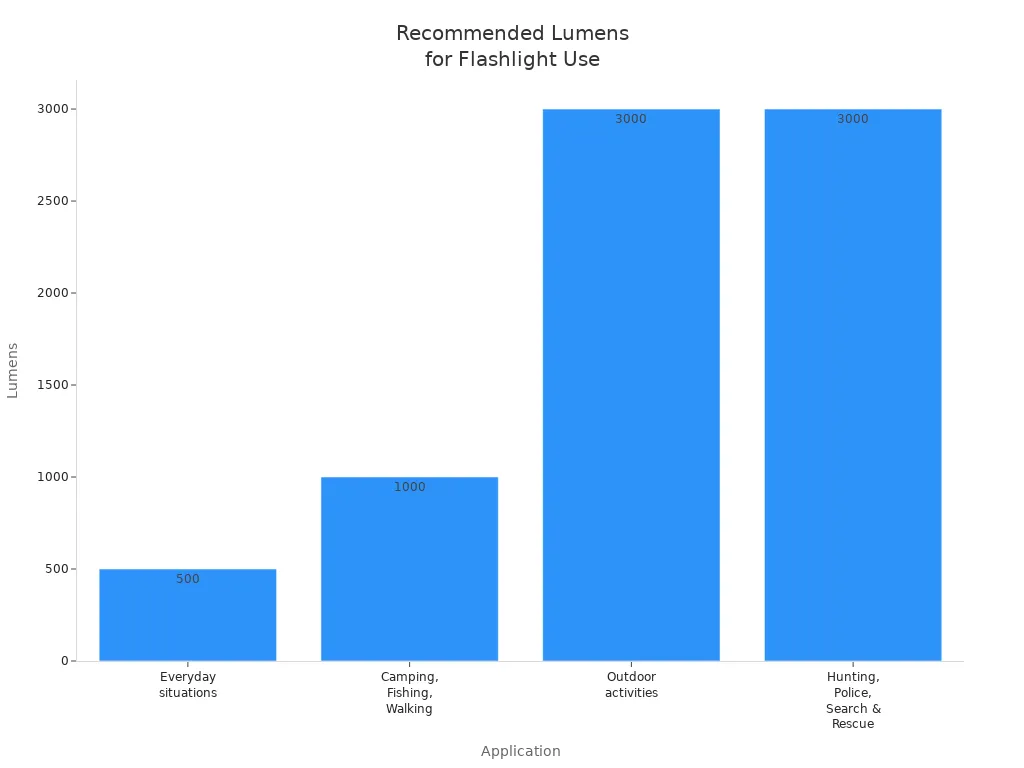
Selecting the right LED power level for professional flashlights depends on your specific environment and tasks. You need to balance brightness, runtime, and safety to match your application. For law enforcement or industrial settings, experts recommend higher lumens. The table below shows typical recommendations:
Application | Recommended Lumens |
|---|---|
Law enforcement | 1000 |
Military/Special Forces | 1000 - 3000 |
Outdoor activities | 1000 - 3000 |
Camping, Hiking | 500 - 1000 |
When you choose professional flashlights, consider adjustable brightness and certified safety ratings. The helius flashlight offers options for every scenario. Your primary environment should always guide your flashlight selection.
Key Takeaways
Choose the right lumen output based on your application. For law enforcement and outdoor activities, aim for 1000 lumens or more for optimal visibility.
Consider durability and safety features. Look for flashlights with high IP ratings and rugged construction to withstand tough environments.
Match brightness levels to your tasks. Use lower settings for routine checks to save battery life, and higher settings for critical situations.
LED Power Levels Explained
What Are Lumens in a Flashlight
Lumens measure the total amount of visible light a flashlight produces. You use lumens to compare brightness between models. The ANSI FL1 Standard sets the industry benchmark for measuring lumens, ensuring you get reliable data when selecting a flashlight. Manufacturers must display these results on product labels, so you can trust the numbers. Lumens help you understand if a flashlight suits your needs, whether you want a wide beam for close work or a focused beam for long-distance tasks.
Tip: Always check the lumens rating before buying a flashlight. Higher lumens mean brighter light, but you should match the output to your environment.
Aspect | Description |
|---|---|
Standard | ANSI FL1 Standard |
Measurement Focus | Lumens for light output; Wattage for power consumption |
Importance of Lumens | Lumens measure the total light output, making them a reliable metric for brightness comparison. |
Limitations of Wattage | Wattage does not directly correlate with brightness due to efficiency of LED technology. |
Testing Consistency | ANSI FL1 ensures consistent testing methods for reliable performance data. |
Additional Factors | Brightness is influenced by candela, optics, battery strength, flashlight mode, and testing methods. |
How Wattage Impacts Performance
Wattage tells you how much power a flashlight consumes. You should not rely on wattage alone to judge brightness, since modern LED technology makes high lumen output possible with lower wattage. The efficiency of LEDs like CREE XHP70.2 and Luminus SFT70 allows you to get more lumens without draining the battery quickly. When you compare led power levels, consider both lumens and wattage to balance brightness and runtime.
Beam Pattern Type | Lumens Range | Candela Range | Optimal Applications |
|---|---|---|---|
Wide Beam Pattern | Higher Lumens | Lower Candela | Close-range tasks, camping, reading |
Focused Beam Pattern | Lower Lumens | Higher Candela | Long-distance searching, security, emergency signaling |
Professional Use | 500-2000+ | High Candela | Law enforcement, industrial inspection, emergency response |
The ANSI/NEMA FL1 standards create a consistent rating system for led power levels.
These standards help you compare flashlights and choose the right model for your job.
Manufacturers must include test results, so you can make informed decisions.
You benefit from advancements like OLED displays, rechargeable batteries, and smart features. These improvements let you control led power levels and maximize high lumen output for any situation.
Industrial Flashlight Selection
Recommended Lumen and Wattage Range
When you work in industrial environments, you need a flashlight that delivers reliable brightness and power. For general tasks, you should choose a model with at least 500 lumens. This level gives you enough light for inspections, repairs, and navigating dim spaces. If you handle detailed work or operate outdoors, select high-power led flashlights with 1,000 lumens or more. These models help you spot hazards and read fine print, even in challenging conditions. For industrial use, a minimum of 1 watt ensures your flashlight maintains steady output during long shifts.
Tip: Use high-power led flashlights with adjustable brightness. Lower settings extend battery life for routine checks, while higher modes provide intense illumination for critical tasks.
You must also consider the size of your workspace. In close-quarters, a wide beam pattern helps you see everything around you. For large-area inspections, a focused beam from high-power led flashlights lets you reach distant corners and overhead structures.
Key Features for Industrial Use
Industrial settings demand more than just brightness. You need a flashlight that stands up to tough conditions and keeps working when you need it most. Look for these essential features:
IP ratings show how well your flashlight resists dust and water. For industrial environments, choose models rated IP67 or higher. These high-power led flashlights keep out fine particles and survive full immersion in water.
Rugged construction matters. Many industrial flashlights withstand drops, chemicals, and pressure. Manufacturers test impact resistance by dropping flashlights from set heights to ensure they keep working after accidental falls.
Water resistance is critical. Flashlights with IPX7 or IPX8 ratings pass immersion tests, so you can use them in wet or flooded areas without worry.
Battery life and LED longevity are key. Industrial jobs often last hours, so you need high-power led flashlights that deliver consistent performance over time.
Note: Always check for certifications and test results. Reliable industrial flashlights display their IP ratings and drop resistance on the packaging.
Helius Flashlight for Industrial Tasks
The helius flashlight stands out as a top choice for industrial professionals. This model combines high-power led flashlights technology with rugged durability and smart features. You get at least 500 lumens for general work, and you can boost output to 1,000 lumens or more for detailed inspections. The helius flashlight uses efficient LEDs, so you enjoy bright light without draining the battery too quickly.
Battery runtime varies by mode. When you use lower settings, the helius flashlight can run all night—perfect for long shifts or emergency repairs. At maximum output, you get intense brightness for up to two hours, ideal for quick inspections or urgent tasks. The helius flashlight offers multiple modes, letting you switch between wide and focused beams as your job demands.
Use the helius flashlight in tight spaces for broad, even light.
Switch to high-power led flashlights mode for large-area searches or outdoor work.
Trust the helius flashlight’s IP67 rating and drop-tested body for reliability in harsh industrial environments.
The helius flashlight gives you the flexibility, power, and toughness you need for any industrial challenge. Whether you work in maintenance, manufacturing, or emergency response, this high-power led flashlights solution keeps you prepared.
Task Type | Recommended Lumens | Helius Flashlight Mode | Typical Runtime |
|---|---|---|---|
Close-quarters | 500+ | Wide beam, low/medium | 3-8 hours |
Large-area search | 1,000+ | Focused beam, high | 30 min - 2 hours |
Emergency response | 1,000+ | Turbo/high-power led flashlights | 30 min - 1 hour |
Choose the helius flashlight for your next industrial project. You get the right balance of brightness, durability, and battery life—no matter where your work takes you.
Tactical Flashlight for Law Enforcement Applications
Lumen Range for Tactical Use
When you work in law enforcement, you need a tactical flashlight that delivers consistent performance in every situation. The right lumen output ensures you see clearly during patrols, searches, and emergencies. For most law enforcement applications, you should choose a tactical flashlight with a lumen range between 500 and 1000. This range gives you enough brightness for patrol duties and close-quarters work. If you handle search operations or need to illuminate large, dark areas, select a tactical flashlight with at least 1000 lumens. Higher output options improve your visibility and help you identify threats or evidence from a distance.
Application | Recommended Lumen Output |
|---|---|
Law Enforcement Patrol | 500 to 1000 lumens |
Search Operations | 500 to 1000 lumens |
Tip: A tactical flashlight with adjustable brightness lets you adapt to changing environments. Use lower settings for routine checks and higher modes for tactical situations.
You should always match the lumen output to your specific tasks. Too much brightness can cause glare in confined spaces, while too little may leave you vulnerable in the field.
Essential Features for Law Enforcement
Choosing a tactical flashlight for law enforcement applications requires you to focus on reliability, durability, and versatility. You need a tool that performs under pressure and withstands daily use in harsh conditions. Professional-grade tactical flashlights use anodized aircraft-grade aluminum for maximum strength. This material resists impacts and rough handling, which is common in law enforcement work. You also need a tactical flashlight with a waterproof rating of IPX6 to IPX8 or higher. This ensures your flashlight keeps working in rain, floods, or during water rescues.
Feature | Requirement |
|---|---|
Material | Anodized aircraft-grade aluminum |
Waterproofing | IP68 rating |
Impact Resistance | Designed to withstand drops and rough handling |
You should also look for tactical flashlights with long battery life and multiple modes. Rechargeable batteries save you money and reduce downtime. Multiple modes let you switch between high output for tactical operations and lower settings for extended use. A rugged build, high brightness, and a durable, waterproof body are essential for law enforcement professionals.
Rugged build for daily field use
High brightness levels for tactical advantage
Long battery life for extended shifts
Versatile modes for different tactical applications
Durable and waterproof construction for all environments
Note: Reliability is critical in law enforcement. Always test your tactical flashlight before every shift to ensure peak performance.
Strobe and Emergency Functions
Strobe and emergency functions set tactical flashlights apart from standard models. In law enforcement, you use the strobe mode to disorient threats and gain a tactical edge. The strobe function confuses suspects, especially in low-light conditions, and can disrupt their ability to focus or respond. This feature is vital for personal defense and security during confrontations.
Evidence Type | Description |
|---|---|
Disorientation | Strobe mode can confuse threats, especially in low-light conditions. |
Tactical Use | The "flashbulb" technique, using brief illumination, helps you confuse adversaries in close quarters. |
Test Results | Tests show strobe lights can distract and impact shooting accuracy, offering a tactical edge. |
You should choose a tactical flashlight with easy-access strobe controls. Quick activation lets you respond instantly in emergencies. Many handheld tactical flashlights include a dedicated strobe button or programmable switch. This design ensures you never fumble for the right mode when seconds count.
Strobe mode for disorienting suspects
Emergency signaling for backup or rescue
Bezel edge for self-defense in close encounters
A tactical flashlight with reliable strobe and emergency features improves your safety and effectiveness in law enforcement applications. You gain control over dangerous situations and protect yourself and your team.
Pro Tip: Practice using the strobe and emergency modes during training. Familiarity with your tactical flashlight’s controls boosts your confidence and performance in real-world scenarios.
When you focus on reliability, performance, and tactical features, you make the best choice for law enforcement. Choosing a tactical flashlight with the right lumen output, rugged construction, and advanced controls ensures you stay prepared for any challenge. Handheld tactical flashlights designed for law enforcement offer unmatched performance and reliability, making them essential tools for every officer.
Outdoor and Emergency Preparedness
Lumen Range for Outdoor Flashlights
You need to match your flashlight’s brightness to your environment for effective outdoor activities and emergency preparedness. In urban settings, a flashlight with 500 to 1500 lumens works well for most emergency response needs. Rural outdoor environments demand more power. Choose a flashlight with 1500 to 3000+ lumens for search and rescue or large-area illumination. The table below summarizes these recommendations:
Environment | Recommended Lumen Range |
|---|---|
Urban | 500-1500 lumens |
Rural | 1500-3000+ lumens |
Features for Emergency Preparedness
A reliable outdoor flashlight supports your emergency preparedness plan. Look for models with long battery life, multiple modes, and robust construction. Many high-performance outdoor flashlights use LED technology for brighter, longer-lasting light. You benefit from features like high, low, strobe, and SOS modes. These options help you adapt to different emergency scenarios, from signaling for rescue to reading maps at night.
Brightness of at least 200 lumens
Runtime of 10+ hours on low mode
Waterproof rating of IPX4 or above
Drop resistance of at least 1 meter
Power source options: AA/AAA or USB-rechargeable (Li-ion)
Long battery runtime is crucial for emergency response. Some outdoor flashlights last several days or even weeks on low settings. Rechargeable models ensure you always have power during extended emergencies.
Rural vs. Urban Use Cases
Outdoor activities in rural areas require flashlights with long beam distance and high output. Search and rescue operations often need a beam distance of 500 meters or more. Adjustable beam settings give you versatility for wide-area coverage or focused rescue tasks.
Feature | Description |
|---|---|
Beam Distance | 500 meters or more for effective rescue and navigation |
Adjustable Beams | Switch between wide and focused illumination for different outdoor scenarios |
In urban outdoor environments, prioritize high lumen output and strobe features for self-defense and emergency signaling. Wilderness use benefits from red or green filters to avoid disturbing wildlife during rescue or preparedness activities.
Outdoor emergency preparedness depends on choosing the right flashlight for your environment. You improve your emergency response and rescue effectiveness by selecting models with the right features and output for your outdoor activities.
Quick Comparison Guide
Lumen and Feature Table by Application
You can quickly compare professional flashlights by looking at their lumen output and key features. The table below highlights what you should expect from each type:
Feature | Police Flashlights | Industrial Flashlights | Outdoor Flashlights |
|---|---|---|---|
Brightness | 800–3000+ lumens for tactical and search tasks | 500–2000+ lumens, task-based | 500–3000+ lumens, environment-based |
Versatility | Multiple modes for patrol, search, and emergencies | Task-specific modes | Multi-functional modes |
Durability | Shockproof, waterproof (IPX6–IPX8) | Industrial-grade, IP67+ | Weather-resistant, IPX4+ |
Power | Rechargeable, quick charging | Long battery life | Varies: rechargeable or replaceable |
Special Features | Strobe, emergency signaling, easy controls | Drop resistance, long runtime | SOS, adjustable beam, color filters |
Tip: Always match the flashlight’s features to your main tasks and environment. This ensures you get the best performance and reliability.
Checklist for Choosing a Flashlight
You can use this checklist to select the right flashlight for your needs:
Define Your Use Case
Identify if you need the flashlight for industrial, law enforcement, or outdoor use.Set Brightness Requirements
Choose the right lumen range: 500+ for industrial, 800+ for tactical, 1500+ for rural outdoor.Decide on Power Source
Pick between USB-rechargeable or replaceable batteries based on your work style.Check Durability Standards
Look for IPX7 or higher and impact resistance for tough environments.Evaluate Beam Modes
Select models with multiple modes for flexibility.Assess Size & Carry Options
Make sure the flashlight fits your carry method and feels comfortable in hand.
Note: Size, output levels, battery type, and control usability all influence how well a flashlight works for you. Always test controls and modes before relying on a new model.
You should match LED power and features to your main tasks. Balance brightness and runtime for safety and efficiency. Avoid common mistakes like neglecting ergonomics or over-prioritizing brightness. Use the table below to guide your choice:
Use Case | Ideal Lumens | Key Tip |
|---|---|---|
Industrial | 500+ | Focus on durability |
Law Enforcement | 800+ | Prioritize reliability |
Outdoor | 1000+ | Choose waterproof |
FAQ
What is the ideal flashlight brightness for emergency response scenarios?
You should choose a flashlight with at least 1000 lumens. This level ensures you have enough light for search, rescue, and other emergency response scenarios.
Can I use a professional flashlight for military and defense operations?
Yes. You can use high-lumen, rugged flashlights for military and defense operations. These models offer durability, reliability, and advanced features for demanding environments.
How do I maintain my professional flashlight for long-term use?
You should clean the lens, check the battery, and store your flashlight in a dry place. Regular maintenance keeps your flashlight ready for any situation.
See Also
How to Select LED Flashlights for Bulk Buying Needs
Benefits of XHP360 LED Flashlights for Wholesale Customers
Selecting Ideal LED Flashlight Suppliers for Your Company
Guidelines for Picking Quality Flashlights for Wholesale
Understanding Lumens and Brightness When Selecting Flashlights